Ely Samuel Parker
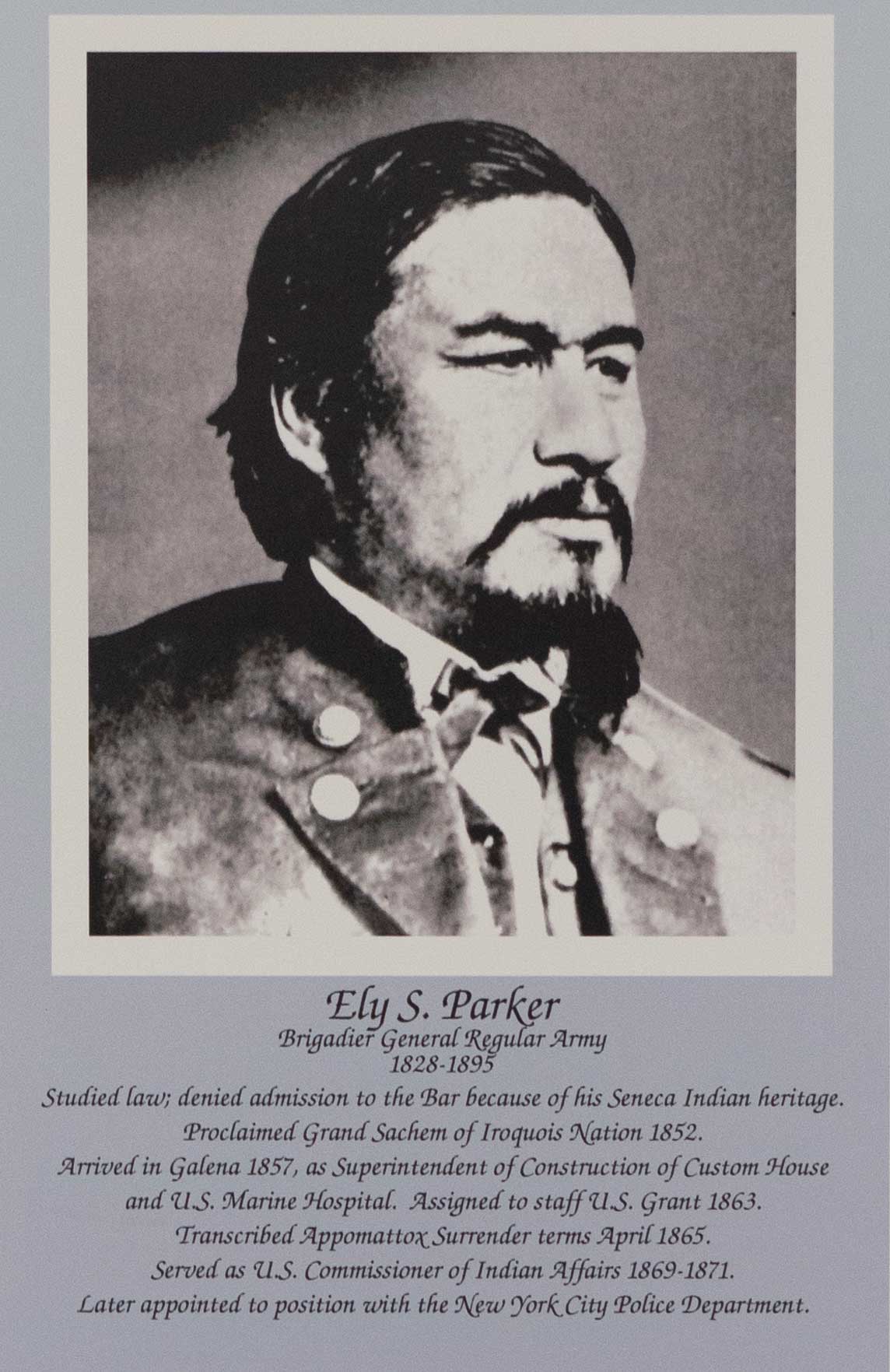
Ely Samuel Parker was born in 1828 on the Tonawanda Reservation near Buffalo, New York into the Wolf Clan of the Seneca Nation. The Seneca were part of the League of the Haudenosaunee, also known as the Six Nations of the Iroquois or Iroquois Confederacy. At birth, he was named Hasanoanda, which translates to “Leading Man.” While raising their children in the traditions and language of the Seneca Nation and the Haudenosaunee, his parents were also pragmatic. They sent their children to a nearby Baptist mission school to learn English and receive an American education. It was at that school that he began to go by the name Ely.
Parker thrived in school. By the time he was in his teens, his fluency in English made him instrumental to Tribal leaders. He began to accompany them on their trips to Albany, New York and Washington, D.C. in defense of tribal treaties with the United States government.
Parker remained dedicated to fighting on behalf of the Seneca and Haudenosaunee people. His influence led to his election as sachem, or chief, of the Tonawanda in 1851. Upon his selection, Parker took the name Donehogawa, or “Open Door.” He held this position for the rest of his life.
He attended the Rensselaer Polytechnic Institute in Troy, New York. Upon completing his studies in civil engineering, he worked on the expansion of the Erie Canal in Rochester, New York before moving to Galena, Illinois in 1857 where he supervised the construction of a federal customs house and a Marine Hospital.
Parker's experience as an engineer was also helpful in surveying the Galena River for the purpose of building a lock. Parker was also appointed superintendent for the construction of a custom house at Dubuque, Iowa.
At the onset of the Civil War, Parker tried to join the Army and recruit other Haudenosaunee men to enlist. His efforts were met with constant refusal. Finally he was told he could join a unit if any would have him.
General John Eugene Smith wrote a letter to Washington requesting and accepting Parker. Ely became chief engineer of Smith's 7th Division and served during the siege of Vicksburg and the Chattanooga Campaign. Following Chattanooga, Parker was appointed Grant’s aide-de-camp and served as his secretary writing most of Grant’s letters. He was also promoted to the rank of lieutenant colonel. Parker served in this capacity through the end of the war.
Perhaps Parker’s most well-known military moment was drafting the terms of surrender at Appomattox Court House on April 9, 1865. When he was done reviewing the document, General Robert E. Lee extended his hand to Parker and stated, “I am glad to see one real American here.” Parker shook the defeated general’s hand and responded, “We are all American.” That same day he was promoted to brevet brigadier general, the highest military rank awarded to any Native Soldier in the war.
In 1867 he sent shockwaves throughout Washington society and the League of the Haudenosaunee when he married a white woman named Minnie Sackett.
Following Grant’s successful presidential election in 1868, he nominated Parker as the commissioner of Indian Affairs, the first Native American to hold the job. Parker resigned in August 1871. He never held political office again.
Parker and his wife moved to Fairfield, Connecticut, and he eventually found a job as a businessman and amassed quite a fortune on Wall Street. His luck, however, did not last. The economic Panic of 1873 hit his fortune hard and he lost all his money. Parker was once again forced to shift careers. He became a desk clerk with the New York City Police Department while also dabbling in public speaking.
By the end of his life, Parker battled kidney disease and diabetes and suffered a series of strokes. He died on Aug. 31, 1895. He was buried with full military honors.
As an additional note: On Nov 14 2025, in a ceremonial courtroom in downtown Buffalo, supporters and direct descendants of Parker gathered for a celebration of his resiliency, with the New York Supreme Court Appellate Division, Fourth Department posthumously admitting him to the bar – 176 years after he had been denied because Native Americans were not considered US citizens.
